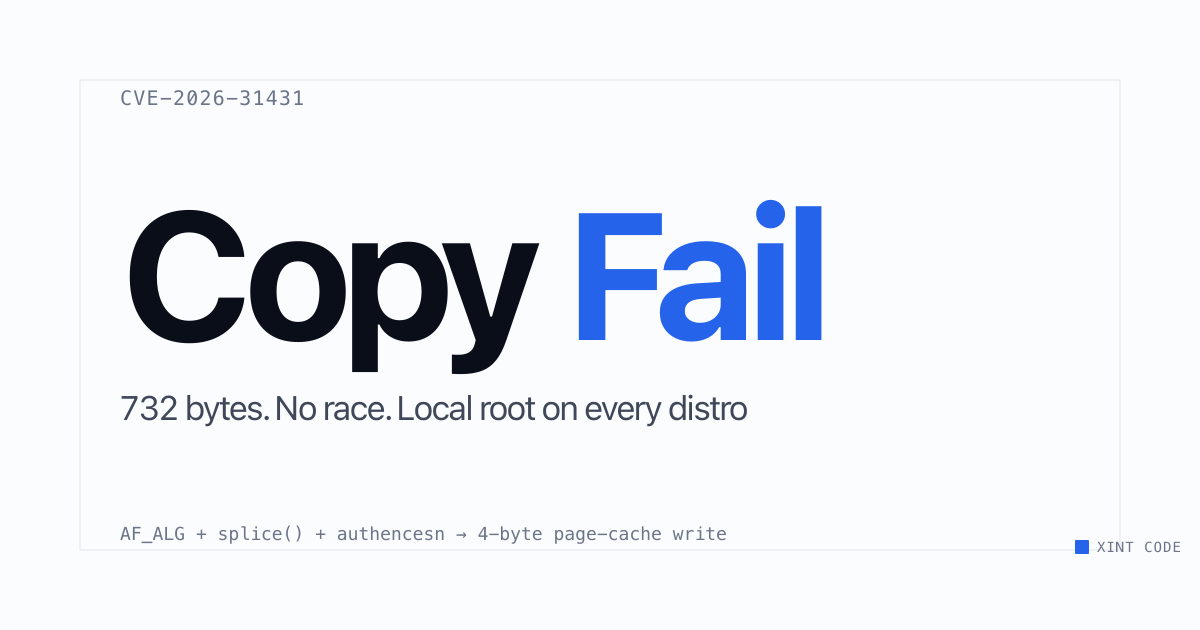
CVE-2026-31431 “Copy Fail”: Important Linux Kernel Vulnerability — What Server Owners Should Know
A newly disclosed Linux kernel vulnerability, CVE-2026-31431 “Copy Fail”, may allow a local user to gain root privileges. Here is what website owners, server admins and businesses should know.


A new Linux kernel vulnerability, tracked as CVE-2026-31431 and also known as “Copy Fail”, has been publicly disclosed. It is being treated as an important security issue because, under the right conditions, it can allow a local user to escalate privileges and gain root-level access on affected Linux systems. CERT-EU describes it as a high local privilege escalation vulnerability, publicly disclosed on 29 April 2026.
This does not mean that every Linux server can be hacked remotely without access. The key point is that the attacker generally needs some form of local code execution first — for example a shell account, a compromised application, a malicious container workload, or code running on a CI/build system.
For server owners, hosting providers and businesses running Linux-based infrastructure, the recommendation is simple: check your systems, apply vendor updates, and reboot where required.
What is CVE-2026-31431?
CVE-2026-31431 is a vulnerability in the Linux kernel’s cryptographic interface, specifically involving the algif_aead kernel module and the AF_ALG crypto API. Ubuntu rates the issue as High, with a CVSS 3.1 score of 7.8, and describes the issue as a “trivial local privilege escalation.”
In practical terms, a local unprivileged user may be able to abuse the vulnerability to become the root user. Red Hat also describes the issue as affecting the Linux kernel’s cryptographic interface and says a user with a local account could trigger the flaw to gain administrator-level privileges.
Why this matters for servers
For a normal single-user desktop or a locked-down single-purpose server, the risk is lower than a remote unauthenticated vulnerability. However, the risk becomes much more serious in environments where untrusted or semi-trusted code may run on the same kernel.
This includes:
- shared Linux servers,
- development boxes,
- CI/CD runners,
- container hosts,
- Kubernetes nodes,
- hosting environments,
- systems where a compromised website could lead to local code execution.
Canonical notes that on hosts without container workloads, the vulnerability allows a local user to elevate privileges to root. In container environments, it may also help enable container escape scenarios where potentially malicious workloads are running.
That is why this vulnerability is especially relevant for hosting, infrastructure and DevOps teams.
Is this a remote attack?
Not directly.
CVE-2026-31431 is best understood as a local privilege escalation vulnerability. An attacker typically needs to already be able to run code on the machine. However, this still matters because many real-world attacks happen in stages.
For example:
- an attacker exploits a vulnerable web application,
- gains limited access as a low-privileged user,
- then uses a local privilege escalation bug to gain root.
This is why local privilege escalation vulnerabilities should not be ignored, especially on internet-facing servers.
Which systems are affected?
According to CERT-EU, the vulnerability affects mainstream Linux distributions shipping kernels built since 2017, until patched versions become available.
Ubuntu says the vulnerability affects Ubuntu releases before 26.04 “Resolute”, and Canonical has released a mitigation through the kmod package that disables the affected module until kernel fixes are available.
Because package status can change quickly, administrators should check the security tracker for their own distribution rather than assuming they are safe.
What should administrators do?
The safest approach is:
- Apply security updates from your Linux distribution.
- Update kernel packages when available.
- Reboot the server if required.
- Prioritise shared servers, container hosts, CI runners and systems running untrusted workloads.
- Temporarily disable the affected module if vendor guidance recommends it.
For Ubuntu systems, Canonical recommends upgrading packages with:
sudo apt update && sudo apt upgradeCanonical also states that if a full upgrade is not possible, the mitigation can be applied by upgrading kmod only:
sudo apt update && sudo apt install --only-upgrade kmodA reboot ensures the mitigation is applied cleanly.
For non-Ubuntu systems, follow your vendor’s official security advisory. Do not blindly copy commands between distributions unless you know they apply to your system.
How to check the running kernel
On most Linux servers, you can check the currently running kernel with:
uname -rOn Ubuntu/Debian-based systems, installed kernel packages can be checked with:
dpkg -l 'linux-image*' | grep ^iiOn RHEL/AlmaLinux/Rocky/Fedora-based systems, administrators can usually check installed kernels with:
rpm -q kernelThe important point is not just whether updates are installed, but whether the machine has been rebooted into the patched or mitigated environment.
What SiteForge recommends
If you manage your own VPS, dedicated server or internal Linux infrastructure, treat this as a priority patching task — especially if the server runs containers, build pipelines, multiple users, or public-facing web applications.
If your website is hosted on a managed platform, ask your provider whether the affected Linux kernel packages and mitigations have been reviewed and applied.
At SiteForge, we recommend keeping infrastructure updated, reducing unnecessary local user access, isolating workloads properly, and monitoring vendor advisories for kernel-level issues like CVE-2026-31431.
Final note
CVE-2026-31431 is not a reason to panic, but it is a reason to act. It is a high-impact local privilege escalation issue, and these vulnerabilities are often used after an attacker has already gained limited access through another weakness.
For businesses, the practical takeaway is clear: patch quickly, reboot where needed, and make sure your servers are not running outdated kernels.
More Information :
 Xint
Xint